

Internet broadcasters
Operate continuous linear channels for web, OTT and social destinations with simultaneous primary and backup RTMP publishing, resilient SRT contribution and hybrid delivery paths.
 Windows Broadcast Software
One Windows application, three broadcast roles. IP Multicoder combines H.264/AVC and H.265/HEVC encoding, SRT/UDP receiving and decoding, and protocol conversion in the same software build.
Capture SDI, HDMI, analogue or Blackmagic DeckLink sources; deliver UHD/4K over SRT or UDP; publish compatible H.264 RTMP; and operate the system remotely through Web Management.
Designed for 24/7 broadcast operations: run continuous internet channels or deliver contribution feeds and DVB MPEG-TS to satellite earth station headend and uplink chains.
One operational platform for always-on internet broadcasters and professional DVB satellite earth station workflows.
Operate continuous linear channels for web, OTT and social destinations with simultaneous primary and backup RTMP publishing, resilient SRT contribution and hybrid delivery paths.

Encode or receive contribution feeds and hand off CBR DVB MPEG-TS over UDP to the headend or satellite uplink chain. Unicast, multicast and SRT paths support professional station routing.

Supervise encoder, decoder and gateway instances remotely through Web Management with live bitrate, uptime, connection state, alarms and system or debug logs.
DVB integration note: IP Multicoder supplies the IP contribution and MPEG-TS handoff. RF modulation, upconversion and transmission remain within the satellite earth station chain.
Switch roles without buying, installing or learning separate applications. The same IP MULTICODER interface handles capture encoding, IP feed decoding and protocol conversion.
Encode SDI, HDMI, analogue or DeckLink sources from SD to UHD/4K and deliver them over SRT, UDP or compatible H.264 RTMP.
Receive and decode SRT or UDP MPEG-TS contribution feeds for monitoring and downstream broadcast workflows from the same application.
Open the browser interface to view bitrate, uptime, connections, alarms and logs, and manage encoder or decoder operations remotely.
A complete Windows contribution toolkit for encoding, decoding, protocol conversion and remote operation — without splitting the workflow across separate products.
Choose widely compatible H.264/AVC or bandwidth-efficient H.265/HEVC. HEVC and UHD/4K are designed for SRT and UDP contribution; RTMP publishing remains H.264 for platform compatibility.
Receive and decode incoming SRT or UDP MPEG-TS feeds in the same application used for encoding. Monitor the decoded programme and connection health from one operational view.
Take SRT or UDP in and route it to SRT, UDP or H.264 RTMP out. Bridge field contribution, studio IP networks, media servers and streaming platforms without another gateway product.
Manage encoder and decoder operations through a browser. Check live bitrate, uptime, connection state, alarms and logs remotely from the local network.
Run the encoder as an SRT listener waiting on a known UDP port, or as a caller that dials out to a remote listener. Caller mode gets a field kit out through NAT and firewalls without inbound rules.
Publish to a primary and a backup RTMP endpoint at the same time. If one path degrades, the contribution feed keeps running on the other instead of dropping the programme.
Take HD or SD SDI, HDMI and analogue sources through supported capture hardware including Blackmagic DeckLink cards. An incoming SRT stream or UDP transport stream can also be used as the source.
Send MPEG-TS over UDP to a single destination or to a multicast group address for in-house distribution, DVB workflows and headend integration.
Control resolution, frame rate, encoder preset, H.264 profile and level, H.265 settings, GOP length and rate control. Use CBR for fixed links or VBR for quality-first delivery.
Upscale or downscale independently of the source resolution, and switch between interlaced and progressive output so the contribution feed matches what the receiver expects.
Watch bitrate, uptime, connection state and packet loss while the encoder runs, so a degrading link is visible before it becomes a dropped feed.
Configurable alarm conditions surface input loss, connection failures and encoding faults immediately rather than leaving an operator to notice a frozen preview.
Full system event and debug logging for post-incident analysis, so an intermittent problem on a contribution link can actually be traced instead of guessed at.
SRT carries AES encryption as a native part of the protocol, so a contribution feed crossing the public internet stays protected in transit without an extra VPN layer.
Run encoding on CPU, or use supported hardware acceleration to keep headroom free when several instances share one machine.
Runs on 64-bit Windows 10, Windows 11 and Windows Server for continuous internet broadcast channels or DVB earth station rack deployments.
Capture or IP source in; encoded, decoded or protocol-converted feed out — including hybrid combinations for parallel delivery paths.
 Inputs Outputs
Configure each encoder, decoder or gateway instance from the desktop dashboard or Web Management interface.
| Application roles | Encoder, decoder/receiver and protocol gateway in one Windows application |
|---|---|
| Video codecs | H.264 / AVC and H.265 / HEVC |
| Profile & level | Baseline, Main and High profiles with selectable level (for example High @ L4.1) |
| Rate control | CBR for fixed-bandwidth contribution links, VBR where quality matters more than a flat bitrate |
| Resolution | SD, HD, Full HD and UHD / 4K, with independent upscaling and downscaling from the source |
| Frame rate | Selectable per instance; interlaced and progressive output both supported |
| GOP structure | Configurable GOP length to balance latency against compression efficiency |
| Encoder presets | Speed and quality presets, plus manual override of individual parameters |
| SRT modes | Listener and caller, with configurable latency buffer and passphrase encryption |
| RTMP publishing | Primary and backup endpoints, published in parallel |
| Codec by protocol | H.265/HEVC and UHD/4K contribution over SRT or UDP; RTMP publishing uses H.264/AVC for broad compatibility |
| UDP output | MPEG-TS, unicast or multicast group address |
| Decoder input | SRT or UDP MPEG-TS receiver and decode workflow |
| Protocol gateway | SRT/UDP input to SRT, UDP or H.264 RTMP output |
| Hybrid modes | RTMP + SRT and RTMP + UDP running concurrently |
| Monitoring | Live bitrate, uptime, connection state and packet loss |
| Web Management | Remote browser access for status, operational control, alarms and logs |
| Alarms & logs | Configurable alarm conditions, system event log and debug log |
| 24/7 operational use | Continuous internet broadcaster and DVB satellite earth station workflows, with remote supervision and parallel delivery paths |
| DVB integration | CBR MPEG-TS over UDP for IP contribution and handoff to the headend or satellite uplink chain; RF transmission equipment is external |
| Operating system | 64-bit Windows 10, Windows 11 and Windows Server |
| Licensing | 15-day trial licence on request; commercial licence quoted per deployment |
Specifications reflect the current release and may change between versions. For a workflow-specific confirmation before purchase, ask our team.
Screenshots from the running encoder — click any image to open it full size.
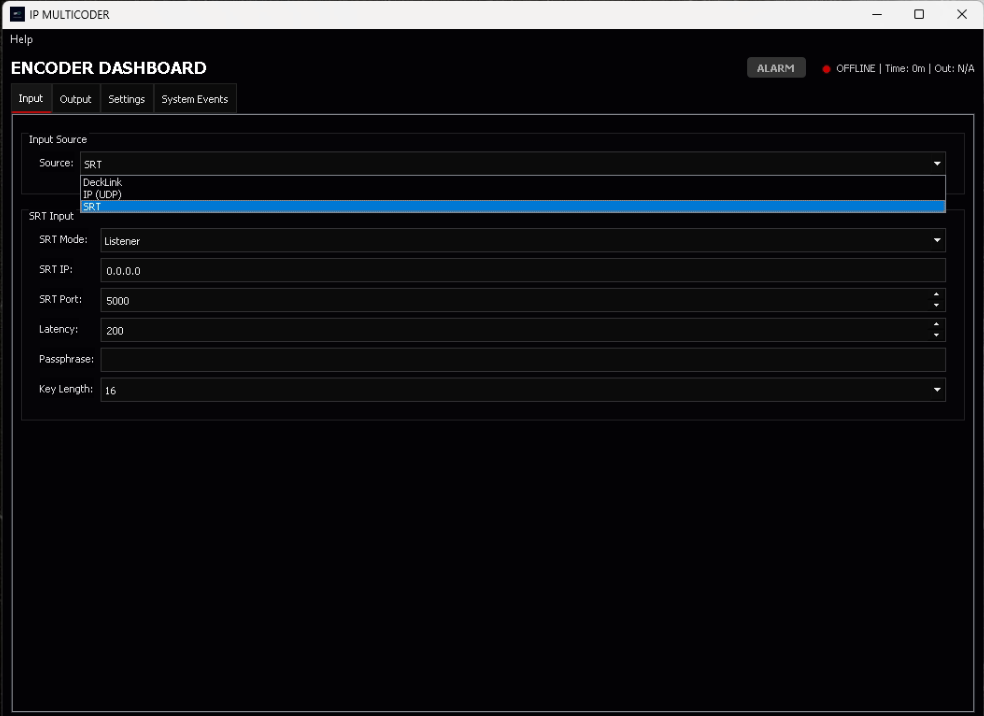
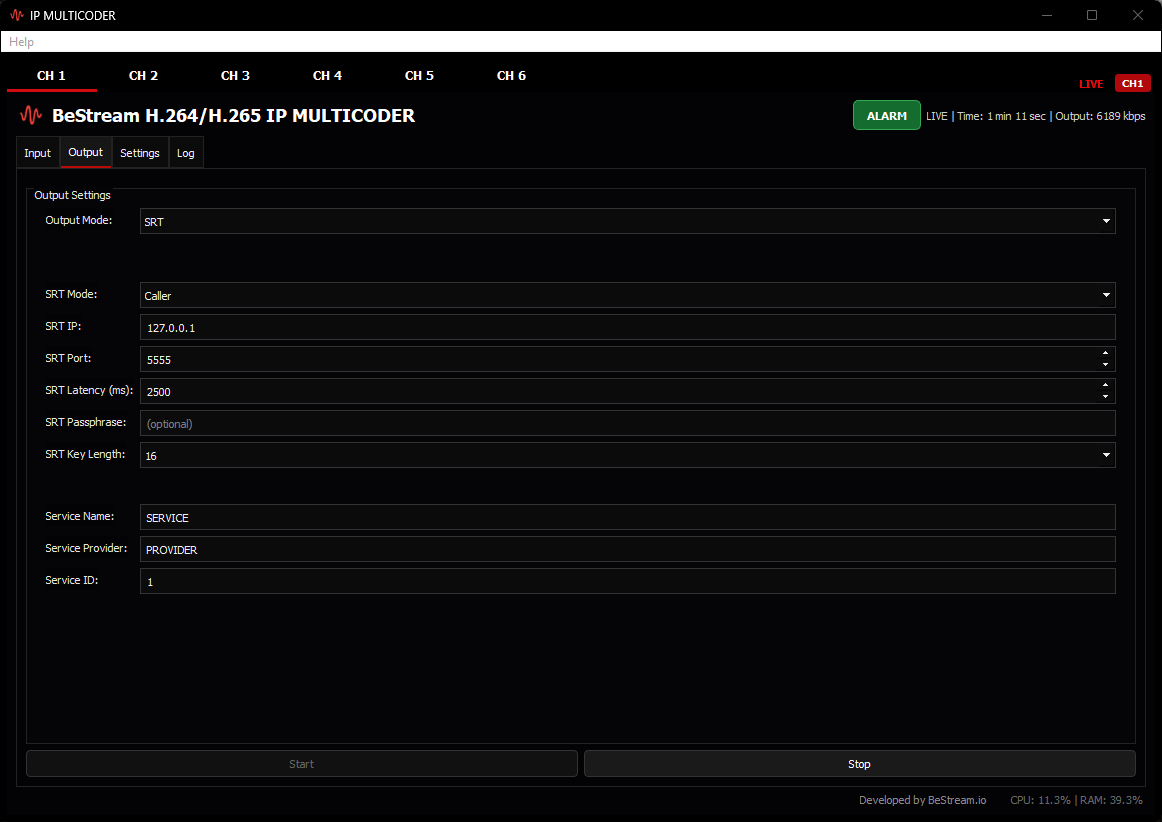
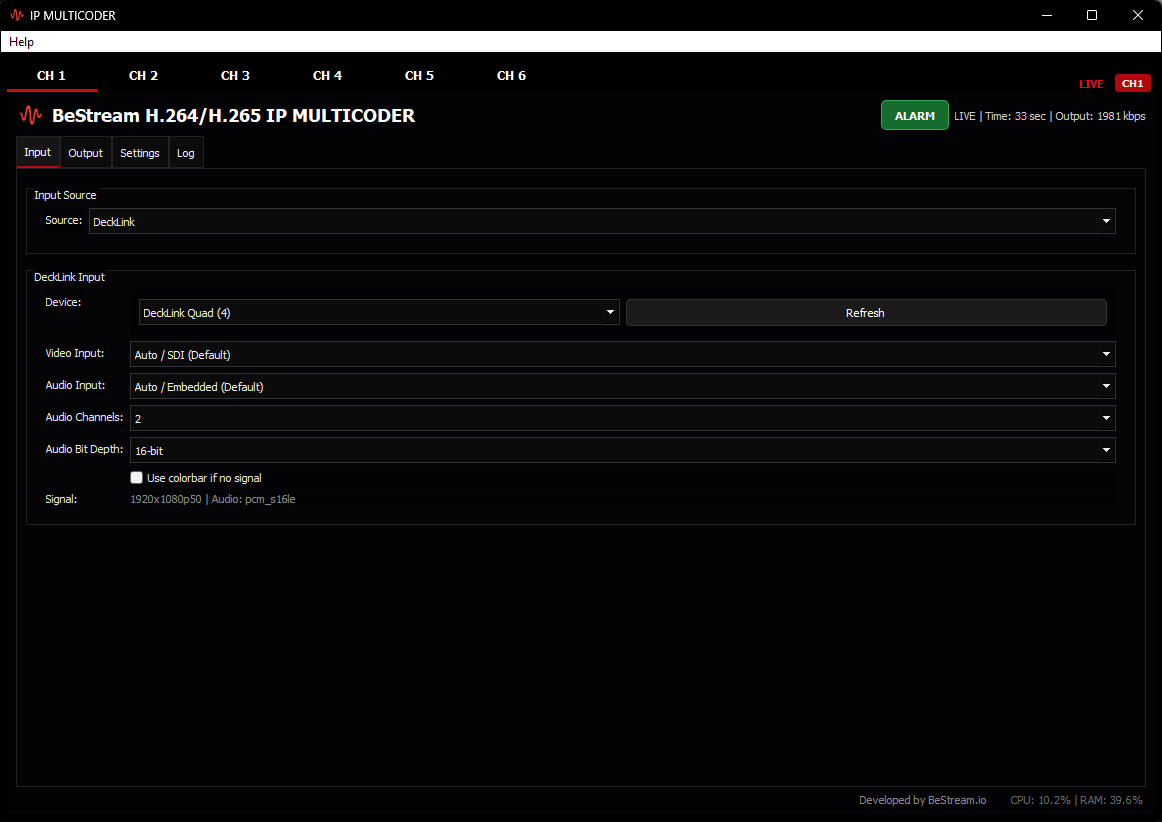
Contribution, distribution, receive and remote-operation patterns handled by the same IP MULTICODER build.
A field kit at a stadium, conference hall or house of worship sends a resilient feed back to the gallery over the public internet. Caller mode dials out, so the venue network needs no inbound firewall rules.
A continuous programme feed goes to web, OTT or social platforms while a second RTMP endpoint stays live in parallel. Operators supervise bitrate, uptime and alarms through Web Management.
An SDI or IP programme source is encoded or converted to CBR MPEG-TS and handed off over UDP to the station headend or satellite uplink chain, with unicast, multicast or resilient SRT contribution available as required.
A studio receives a remote H.264 or H.265 contribution stream over SRT or UDP. Decoder mode locks to the feed, displays operational health and makes it available to the downstream broadcast chain.
An operator opens the browser interface from another workstation to supervise encoder and decoder instances, check bitrate and uptime, review alarms and inspect logs without standing at the encoding PC.
Sizing depends on resolution, bitrate and how many encoder instances share the machine. Tell us your workflow and we will confirm what the hardware needs to be.
Test H.264/H.265 encoding, SRT/UDP decoding, protocol gateway operation and Web Management in your own 24/7 internet broadcast or DVB satellite earth station chain. Tell us the source, target format and destination and we will prepare the right configuration.


